
Choosing the right dewatering methods is critical for any mining or construction project that extends below the water table. Excess groundwater can flood excavations, weaken soils and lead to costly downtime, project delays and safety risks.
In short: wellpoint dewatering suits shallow excavations in sandy soils, deep well dewatering suits deep excavations and mines, and the right method depends on soil conditions, excavation depth and water volume.
Groundwater dewatering lowers the water table around a work area so excavation can proceed in dry, stable conditions. Common approaches range from wellpoint dewatering for shallow excavations to deep well systems for larger, deeper sites. Each relies on sound dewatering system design and, in most cases, dewatering drilling to install the bores that extract the water.
What Is Groundwater Dewatering?
Dewatering is the process of removing groundwater or surface water to control groundwater levels during excavation, construction or mining. Water is drawn from wells, bores or sumps and discharged away from the excavation area.
Effective groundwater control protects:
- Worker safety, by reducing the risk of site flooding and unstable excavation walls
- Structural integrity of foundations, retaining walls and nearby buildings
- Project timelines, by preventing water inflow that halts work
- Equipment, by limiting equipment failures caused by wet conditions
Common Dewatering Methods
The right dewatering method depends on excavation depth, soil conditions, groundwater levels, and the volume of water to be removed. These are the most widely used systems.
Wellpoint dewatering
Wellpoint dewatering uses a line of small-diameter wells, called wellpoints, installed at close spacing around the excavation perimeter. Each wellpoint connects to a header pipe linked to a vacuum pump, which draws water up and out of the ground.
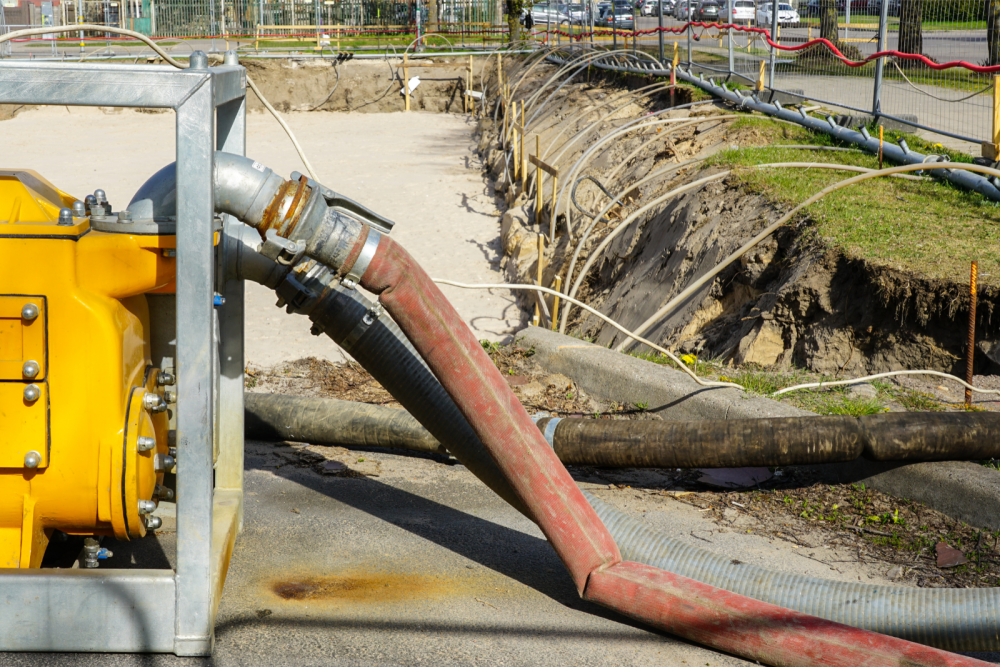
Wellpoint systems work well in sandy soils and are widely used on Perth’s Swan Coastal Plain. Because they rely on suction, a single stage typically lowers the water table by around 5 to 6 m. Deeper excavations need multiple stages or a different method.
Deep well dewatering
Deep well dewatering uses larger-diameter bores, each fitted with a submersible pump. Because each pump sits down the bore, the system is not limited by suction lift.
A deep well system suits deep excavations, large sites and high water inflow, and it is the standard approach for mine dewatering. Fewer, more widely spaced bores can lower groundwater across a large area, making it a cost-effective dewatering solution for long-term works.
Eductor wells
Eductor systems pump high-pressure water down each well through a nozzle, creating a vacuum that draws groundwater in. They perform well in low permeability soils, such as silts and clayey sands, and can work deeper than a single stage of wellpoints.
Sump pumping
Sump pumping collects water in pits within the excavation, where sump pumps remove it. It is the simplest option for shallow excavations, surface water and heavy rainfall. However, water enters the excavation before it is removed, which can undermine slopes in fine sands.
Bypass dewatering
Bypass dewatering uses pumps installed upstream to divert sewage flow around a work area, so crews can repair sewer lines in dry conditions.
Comparing the main dewatering methods
| Method | Drawdown depth | Best suited to | Key consideration |
|---|---|---|---|
| Wellpoint | Around 5 to 6 m per stage | Sandy soils, shallow excavations, trenches | Limited by suction lift |
| Deep well | Large drawdowns, including mine pits | Deep excavations, large sites, mining | Higher drilling cost per bore |
| Eductor | Beyond a single wellpoint stage | Low permeability soils | Lower pumping efficiency |
| Sump pumping | Shallow | Surface water, rock, cohesive soils | Water enters the excavation first |
Dewatering Projects in Construction and Mining
Construction dewatering for deep excavations
Construction dewatering allows basements, footings, pipeline trenches and tunnelling projects to be built safely below the water table. In Perth, shallow groundwater and sandy soils mean dewatering is required on many construction projects, from basements to major infrastructure.
Dewatering involves more than removing water. Lowering groundwater too far or too quickly can cause ground settlement, so the system must be designed to protect nearby structures and services.
Deep well systems for mine dewatering operations
In mining, dewatering keeps open pits and underground workings dry, stabilises pit walls and improves working conditions. Many Pilbara and Goldfields mines extend below the water table, so dewatering operations often run for the full project lifecycle.
Mine dewatering typically combines deep bores around the pit with in-pit sumps. The extracted water may be reused for dust suppression and processing, discharged under licence or returned to the aquifer through reinjection wells.
The Dewatering Process and System Design
Good dewatering system design starts with understanding the ground. A typical dewatering process follows these stages:
- Site investigation: boreholes, soil sampling and packer permeability testing to assess soil composition and permeability.
- Groundwater monitoring: vibrating wire piezometers or standpipe piezometers to record groundwater levels and seasonal changes.
- Test pumping: pumping a trial bore to measure how the aquifer responds.
- System design: selecting the method and setting the number, depth, spacing and pump capacity of wells.
- Dewatering drilling and installation: drilling and constructing the bores or wellpoints.
- Operation and monitoring: tracking drawdown, pump performance, water quality and discharge throughout the works.
Dewatering drilling and bore construction
The performance of a dewatering system depends heavily on how well its bores are drilled and built. Each bore is typically fitted with casing and a slotted screen, surrounded by a gravel pack, then developed to remove fines and maximise yield.
Poorly constructed bores can draw in sand, reduce flow and wear pumps, particularly where light abrasives are present. Mud rotary drilling and air hammer methods are commonly used to install dewatering boreholes, depending on ground conditions and bore depth.
Managing Complex Site Conditions
Soil and groundwater conditions
Soil conditions have the greatest influence on method selection. Sandy soils drain readily and suit wellpoints, while low permeability soils may need eductors or closer well spacing. Variable layers, perched water and confined aquifers all require careful investigation before design.
Protecting the construction site and nearby structures
Uncontrolled drawdown can cause settlement and affect site stability well beyond the excavation. Monitoring groundwater levels at the site boundary confirms the system is performing as designed and protects neighbouring property.
Environmental compliance in Western Australia
Groundwater is regulated in Western Australia. In a proclaimed groundwater area, it is illegal to take water without a licence or valid exemption. The Department of Water and Environmental Regulation (DWER) issues water licences under the Rights in Water and Irrigation Act 1914.
Checking the proclaimed area maps and licensing requirements early in planning supports regulatory compliance and helps avoid project delays.
How Precision Drilling Australia Supports Dewatering Projects
We drill and install dewatering bores for dewatering contractors, builders and mining companies across Perth and regional Western Australia. Our licensed Class 1, 2 and 3 water well drillers use mud rotary and air hammer methods to construct bores built for reliable, long-term performance.
Our hydro and water drilling capability also covers mine dewatering bores, monitoring bores, test pumping and VWP installations. This allows investigation, installation and monitoring to be delivered by one contractor, under our ISO 45001 certified HSEQ systems. For example, our Rig 6 team recently began a major groundwater investigation in the Pilbara for a Tier 1 client, installing groundwater monitoring bores. Learn more about our construction dewatering services.
Speak With Our Team
Planning a dewatering project? Get in touch to discuss your site conditions and bore requirements with our experienced team. Contact our team today.
You can also download our capability statement to learn more about our fleet, services and HSEQ systems.
Dewatering FAQs
Wellpoint dewatering is one of the most common methods for shallow construction excavations in sandy soils. For deeper excavations and mining, deep well dewatering is generally preferred.
Wellpoints are small, closely spaced wells connected to a vacuum pump, suited to shallow excavations. Deep wells are larger bores with individual submersible pumps, suited to deep excavations and large areas.
A single stage of wellpoints typically lowers the water table by around 5 to 6 m. Deeper excavations may use multiple stages, eductor wells or deep wells.
In a proclaimed groundwater area, taking groundwater requires a DWER licence or a valid exemption. Check whether your site sits within a proclaimed area early in planning.


