
RC drilling vs diamond drilling is one of the most important decisions in any mineral exploration program. Both drilling methods are proven across the Australian mining industry, but they produce different samples, at different costs, with different levels of geological detail.
In short: RC drilling is faster and cheaper for testing grade across many holes, while diamond drilling provides the intact core needed for structural, geotechnical and resource work.
The reverse circulation drilling method returns rock chips to the surface quickly and cost-effectively, making it the workhorse of resource definition and grade control. Diamond drilling exploration recovers intact core samples, which show structure, lithology and mineralisation as they sit in the ground.
The right choice, or the right combination of both, affects your data quality, timelines and budget. This guide explains how each drilling technique works, how they compare and when to use each.
Common Drilling Methods for Mineral Exploration
Mining companies and explorers typically choose from three main drilling methods, each suited to a different stage of a program:
- Air core drilling: fast, low-cost drilling for early-stage exploration through soft, weathered ground
- Reverse circulation (RC) drilling: rock chip samples for geochemical analysis and resource definition
- Diamond core drilling: solid core for geological information, structural analysis and geotechnical testing
Other drilling methods, such as RAB, are used less often in modern hard rock exploration. This article focuses on RC and diamond drilling. Our guide to air core vs RC drilling covers the earlier stage of that decision.
How Does Reverse Circulation Drilling Work?
Reverse circulation (RC) drilling uses a downhole hammer, often called an RC hammer, to break rock at the bottom of the drill hole. The hammer is a pneumatic reciprocating piston driven by compressed air. It strikes a drill bit fitted with tungsten carbide buttons, which crushes the rock into chips.
The RC drilling process
- Compressed air travels down the gap between the outer tube and inner tube of dual-wall drill rods.
- The air powers the hammer and forces the rock cuttings into the inner tube at the bit face.
- The drill cuttings travel up the inside of the drill string to the surface.
- A cyclone separates the cuttings from the air, and a cone or riffle splitter divides each metre into a representative sample.
- Each sample is collected in a numbered sample bag for geochemical analysis.
Because samples travel inside the inner tube rather than up the open hole, contamination from the hole wall is greatly reduced. Modern RC rigs are also fitted with dust suppression systems to protect crews and the surrounding environment.
RC drilling is typically used at shallower depths than diamond drilling. Achievable depth depends on ground conditions, groundwater and air pressure, with booster compressors used to return dry cuttings from greater depths.
Strengths of RC drilling
- Fast penetration rates, so more metres are drilled each shift
- Lower cost per metre than diamond drilling
- Representative samples for assay, resource definition and grade control
- Reliable in hard rock, where air core drilling reaches refusal
- Quick rig moves between holes, suiting large programs
Limitations of RC drilling
RC samples are crushed rock chips, so geological detail is limited compared with core. Geologists cannot measure structures, fractures or the orientation of mineralisation. Below the water table, wet samples are harder to split accurately, which can affect sample quality.
How Does Diamond Core Drilling Work?
Diamond core drilling uses a rotating diamond-impregnated drill bit attached to the end of the drill rods. These diamond bits contain industrial diamonds set in a metal matrix. The bit is ring-shaped, so it cuts a solid cylinder of rock rather than crushing it.
Retrieving intact core samples
- As the bit advances, cylindrical core samples feed into an inner tube within the core barrel.
- Water and drilling fluids cool the bit, stabilise the hole and flush fine cuttings to the surface.
- At the end of each run, a wireline overshot is lowered inside the rods to retrieve the inner tube.
- The core is placed in core trays and logged by geologists.
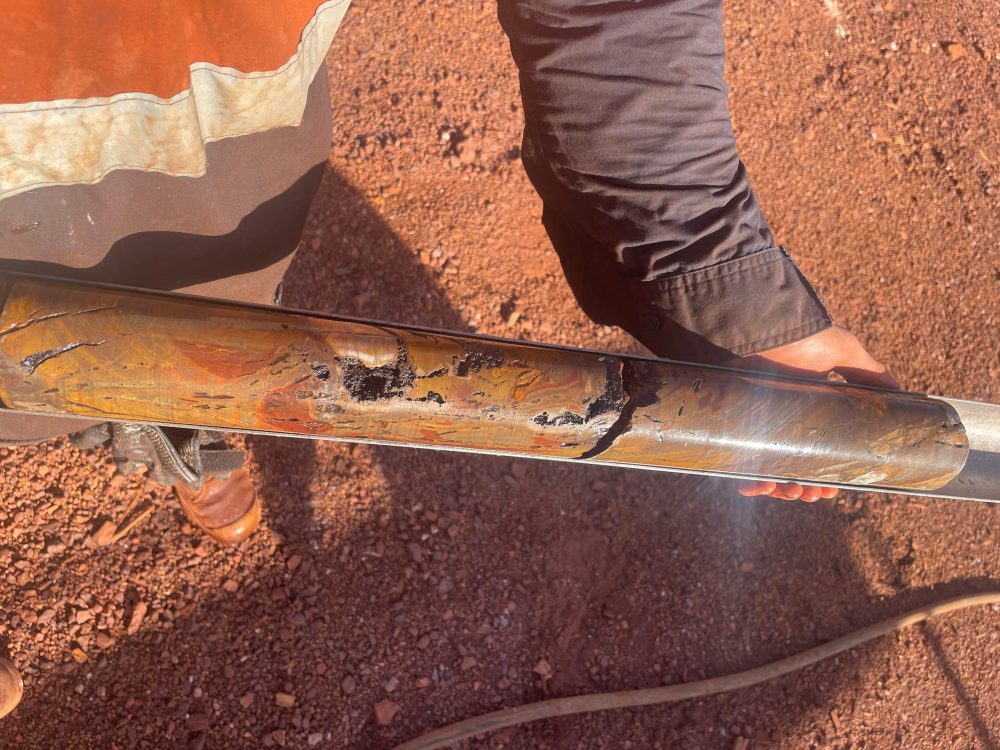
Wireline retrieval means the drill string stays in the hole between runs, which keeps drilling efficient at significant depths. Common core sizes include PQ3 (83 mm), HQ3 (61.1 mm) and NQ3 (45 mm). Smaller core sizes allow holes to reach greater depths than larger core sizes.
Strengths of diamond drilling
- Intact cores that preserve lithology, contacts and mineralisation
- Structural information from oriented core, including faults, veins and fractures
- Geotechnical data such as RQD and rock strength for mine design
- Large-diameter PQ core for metallurgical testwork and bulk sampling
- Handles geological complexity, with triple tube core barrels protecting core in broken or faulted ground
Limitations of diamond drilling
Diamond drilling is slower than RC and comes at a higher cost per metre. It also needs more water, drilling fluids and skilled operators, which requires careful planning at remote sites.
RC Drilling vs Diamond Drilling: Key Differences
The main difference is the sample. RC produces rock chips for chemical analysis. Diamond drilling produces solid core for detailed geological, structural and geotechnical assessment.
| RC Drilling | Diamond Drilling | |
|---|---|---|
| Sample type | Rock chips (drill cuttings) | Cylindrical solid core |
| Geological detail | Limited, mainly lithology and grade | Detailed lithology, structure and texture |
| Structural analysis | Not possible | Possible with oriented core |
| Penetration rates | Fast | Slower |
| Cost per metre | Lower | Higher |
| Typical drilling depth | Shallower than diamond drilling | Greater depths than RC |
| Water use | Minimal | Higher |
| Best suited to | Resource definition, infill, grade control | Discovery, structural, geotechnical and metallurgical work |
Core samples vs rock chips
Rock chips are ideal for geochemical analysis. They tell you what is in the rock and at what grade. Core samples go further, showing how mineralisation is arranged, which structures control it and how the rock will behave during mining.
Drilling depth and ground conditions
Both methods perform well in hard rock. RC is most efficient above the water table, where dry cuttings give the best sample quality. Diamond drilling reaches greater depths and copes better with broken, faulted or water-bearing ground.
Drilling efficiency and cost
RC drilling offers faster penetration rates and a lower cost per metre, making it the more cost-effective choice for drilling large numbers of holes. Diamond drilling comes at a higher cost, but each metre delivers far more information. The most efficient program uses each method where it adds the most value.
Which Method Should You Use for Mineral Exploration?
The right choice depends on your exploration stage, target depth, ground conditions and the data your geologists need. Many mining projects use both methods at different stages.
Choose RC drilling when
- You need to test a mineralised zone across many holes
- Assay data and grade are the priority
- Budget and speed are key constraints
- You are completing infill or grade control drilling ahead of mining
Choose diamond drilling when
- You need to understand the structural controls on an ore body
- Geotechnical data is required for pit or underground design
- Samples are needed for metallurgical testwork or feasibility studies
- Targets sit beyond the practical depth of RC
- You need high-confidence data to report mineral resources under the JORC Code
Combining RC and diamond drilling
Many exploration drilling programs in Western Australia use RC pre-collars with diamond tails. RC drills quickly through the barren upper section of the hole, then diamond drilling cores the target zone. This reduces overall cost and time while still delivering core where it matters most.
Choosing the Right Drilling Method for Your Next Project
At Precision Drilling Australia, we deliver RC and diamond drilling for mineral exploration across Western Australia, the Northern Territory and South Australia. Our drilling rigs and equipment are built to Tier 1 mining specifications, and every crew holds a minimum Certificate III or IV in Drilling Operations. We have delivered drilling programs for clients including Rio Tinto, BHP, FMG, Iluka, Gold Fields and Newmont.
We work closely with your geologists to select the method, or combination of methods, that suits your targets, ground conditions and budget. Our ISO 45001 certified HSEQ systems and real-time CorePlan reporting give you full visibility of safety, progress and costs.
Get in Touch
Get in touch to discuss your next drilling program, and our experienced team will help you select the method that suits your specific project requirements. Contact our team today.
You can also download our capability statement to learn more about our fleet, services and HSEQ systems.
RC Drilling vs Diamond Drilling FAQs
Not entirely. RC provides reliable assay data, but it cannot provide intact core for structural, geotechnical or metallurgical analysis. Most resource projects use both methods.
RC drilling uses a downhole hammer and compressed air to return rock chips to the surface for assay. Diamond drilling uses a diamond bit to cut and recover solid core, which provides detailed information on structure and rock quality as well as grade.
Yes, in most cases. RC drilling has faster penetration rates and a lower cost per metre, which makes it more cost-effective for drilling large numbers of holes.


